EMERGENCY AND CRITICAL CARE: ASSESSMENT AND TREATMENT OF THE CRITICALLY ILL PATIENT PART THREE
| Course Overview |
|
A frantic client is on the phone with a pet that will not stop seizing; a HBC cat is rushed through the front door; a patient is in treatment who is critical and requires ICU level medical care - one of the realities of veterinary medicine is that emergencies can and will happen. As a veterinary technician are you prepared to respond? Do you have the skills and knowledge needed to provide advanced critical care for hospitalized patients?
ECC: Assessment and Treatment of the Critically Ill Patient: Part Three is designed to build on the knowledge base of experienced technicians. This 6-week advanced level course covers parenchymal and non-parenchymal respiratory emergencies, and considerations such as pulmonary thromboembolism, pneumonia, respiratory failure, and pleural space disease along with thoracocentesis, tracheostomy and other related topics. It also reviews procedures and treatment of urinary and reproductive emergencies as well as ARF/CRF and dystocia. This course contains includes challenging assignments that will require the student to utilize professional experience and critical thinking skills, along with new concepts and knowledge acquired through the course materials. Participants are not required to work in practice to complete this course.
Note: Each of the courses in the ECC: Assessment and Treatment of the Critically Ill Patient series is free-standing and participants may take the courses in any order. All 4 courses in the series utilize the same textbook.
This course was formally titled Advanced Principles of Emergency Patient Care, Part Three.
|
| Continuing Education Credits |
Course meets the requirements for 15 RACE hours of continuing education credit for veterinary technicians in jurisdictions which recognize AAVSB's RACE approval. However, participants should be aware that some boards have limitations on the number of hours accepted in certain categories and/or restrictions on certain methods of delivery.
This course is an interactive online course that meets RACE requirements; program number 57-19491.

|
| Veterinary Technician Specialty Academy Acceptance |
|
|
| Course Content |
|
Some of the topics discussed in this course are parenchymal and non-parenchymal respiratory emergencies, and considerations such as pulmonary thromboembolism, pneumonia, respiratory failure, and pleural space disease along with thoracocentesis, tracheostomy and other related topics. It covers procedures and treatment of urinary and reproductive emergencies as well as ARF/CRF and dystocia. This course is specific to dogs and cats; it does not include large animals or exotics.
|
| Course Focus and Learning Objectives |
ECC: Assessment and Treatment of the Critically Ill Patient: Part Three is an advanced 6-week course designed for veterinary technicians who already have a good baseline knowledge of emergency and critical care medicine.
Upon completion of the course, the student will be able to:
- Differentiate between parenchymal and non-parenchymal diseases
- Appraise a patient’s respiratory pattern and recognize abnormalities along with possible causes
- Recognize upper airway, chest wall, and pleural space diseases and discuss the pathophysiology
- Provide monitoring for patients receiving oxygen supplementation and discuss the advantages and risks of oxygen supplementation
- Calculate and analyze a patient’s A-a gradient
- Distinguish between a V/Q mismatch, diffusion impairment, and shunt
- Discuss the uses of respiratory, urinary, and reproductive medications
- Differentiate between ALI and ARDS
- Determine when a patient is in respiratory failure and implement appropriate medical care
- Distinguish between ARF and CRF
- Assist with a thoracocentesis or tracheostomy
- Manage a patient with a urinary catheter and calculate urinary production
- Discuss the causes and treatments for dystocia
- Recognize a patient with pyometra
- Discuss other reproductive diseases including mastitis and paraphimosis
|
| Participation Access Parameters |
|
The design of this course allows participants to enroll at any time.
After enrolling, please allow up to 48 hours for course activation. Each participant will have a personal start and end date that begins upon activation.
|
| Required Materials |
Small Animal Critical Care Medicine Authored by: Deborah Silverstein DVM, DACVECC and Kate Hopper BVSc, MVSc, DACVECC
Important Text Information:
It is mandatory that each participant has access to this textbook as the content of the book is not reproduced within the course. It is up to each person to determine the best way to acquire the text. Some will already have the text in their library and, therefore, will not need to purchase another copy. The text is available as a print publication and as an eBook. Where to purchase and in what format is totally up to the participant. The text is not included in the fee for this course.
USA residents: Elsevier texts, both print and eBook, are available via the VetMedTeam Elsevier Text Portal at discounts off regular retail of 25 - 35 %. If you would like to visit the portal to take advantage of the discount please use this link:
VetMedTeam's Elsevier Text Portal
Important: Regardless of which option the participant chooses, access to a copy of the textbook is mandatory. Without the text, the student will not be able to complete the assignments, case studies and examinations. If enrolling close to or beyond the course start date, it is recommended that the text be purchased as an eBook to prevent text acquisition related delays. VetMedTeam has no control over shipping delays and other related problems.
|
| Additional Courses Using Required Text |
The textbook used in this course is also used in the following courses. Click on the course title to view details regarding that course.
|
| Course Completion Requirements |
Completed students are awarded a certificate of completion. Completion requirements include:
- Instructor Graded Interactive Module Assignments: Designed to help the participant reinforce newly learned material
- Instructor Graded Interactive Case Study Assignments: Designed to help the participant apply the newly learned skills and knowledge though patient and practice based scenarios
- Examinations: All examinations must be submitted with a score of 80% or better
- Course survey
|
| Participant Feedback |
|
...I took this course for the respiratory disease portion and felt it was very helpful to my understanding of disease processes..
...Although it was difficult I enjoyed learning the physiological reasons for respiratory issues. I needed to do a lot of outside the course studying to understand the concepts fully.
...The technical analysis of A-a grad, and urine output are most beneficial since interpreting values is not a requirement as a technician but is extremely helpful in flagging a case for the veterinarian to assess if you can recognize when they are abnormal and what it means.
...Loved the urinary section, calculations to measure urine production.
...The required text is very beneficial and has plenty of information to learn from. The case studies of the course were also helpful and allowed for a more extensive view of a presenting patient and underlying conditions.
...The instructor comments were helpful, very educational.
...I took this course for the respiratory disease portion and felt it was very helpful to my understanding of disease processes.
...I liked having to calculate out the different formulas that were shown the best. ie; urine output, A-a gradient, etc.
...I really loved the case studies. I love being able to apply what I learned to the cases. I also like applying the knowledge to cases that I had previously. It helps me understand those case a lot better.
...I really liked learning about urinary catheterization and maintenance because we so a few patients a week with urinary obstructions.
|
| Course Instructor |
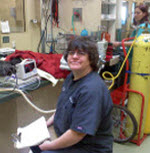 Brandy Tabor, BS, CVT, VTS (ECC) Brandy Tabor, BS, CVT, VTS (ECC)
A native of Colorado, Brandy graduated from Colorado State University in the spring of 2003 with a BS in Equine Sciences. While attending CSU, she worked as a nurse's assistant in the Critical Care Unit at the Colorado State University Veterinary Teaching Hospital. Here, she learned just how far you can go with a career as a veterinary technician. She enrolled in Front Range Community College in Loveland, CO, graduating in 2005. Brandy then moved to Parker, CO where she currently works as a senior emergency and critical care technician. She had the honor of becoming a member of the Academy of Veterinary Emergency & Critical Care Technicians in 2008.
Brandy has a passion for writing and has written several papers for Today's Veterinary Practice, Veterinary Nursing Journal, Today's Veterinary Technician, and Veterinary Technician. She is also a contributor in the 5th edition of Review Questions and Answers for Veterinary Technicians. In addition she is the current chair of the AVECCT Credentials Committee.
Brandy currently lives with two birds, two cats, and two dogs.
|
| Pricing |
Price: $179.00 USD
This course is eligible for the 10% Multi-course discount. To learn more about the discount please visit the Multi-Course Discount page.
|